Day Break: A Brushed and Rough Lettered Display Font for Impactful Design
In a digital landscape saturated with sterile, geometric sans-serifs and overly polished serif fonts, finding a typeface that commands immediate attention without sacrificing readability is a significant challenge. Day Break emerges as a compelling solution for designers seeking to inject texture, authenticity, and raw energy into their projects. Defined by its brushed and rough lettered display style, this font offers a tactile quality that mimics the imperfections of hand-painted signage or weathered urban art.
This analysis explores the functional utility of Day Break, examining how its unique characteristics serve professional needs across various creative sectors. Whether you are a marketer crafting a campaign for a gritty brand or an educator creating engaging materials, understanding the specific application of this typeface is essential for maximizing visual impact.
The Anatomy of Texture: What Defines Day Break?
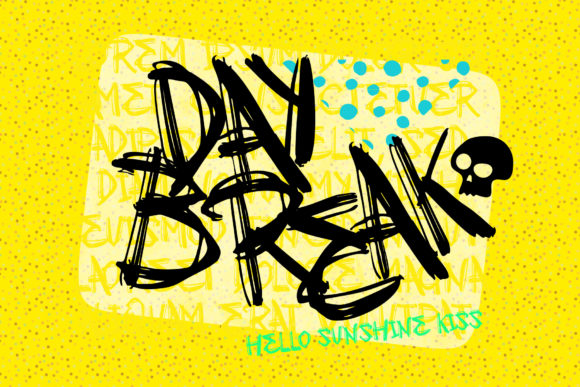
Typefaces generally fall into categories based on stroke uniformity and edge precision. Day Break diverges from these norms by embracing irregularity. The defining characteristic of this font is its "brushed" aesthetic. Unlike standard brush scripts that often feature smooth, flowing transitions, Day Break retains the friction of a dry brush moving across a rough surface. This results in edges that are jagged, textured, and uneven.
The "rough" descriptor is not merely stylistic; it is structural. The letterforms appear to have been applied with pressure, resulting in variations in line weight that feel organic rather than digitally calculated. When you add Day Break to your favorite creative ideas, you notice how it makes them come alive because it introduces a human element that automated design tools often lack. It simulates the physical act of creation, providing a sense of history and effort in every character.
This texture serves a dual purpose. Visually, it creates depth, making flat text appear three-dimensional. Functionally, it signals authenticity. In an era where consumers are increasingly skeptical of hyper-polished corporate imagery, the roughness of Day Break suggests honesty, durability, and a "real world" connection.
Visual Characteristics and Readability
While Day Break is classified as a display font, meaning it is optimized for headlines, logos, and large-format text rather than body copy, its legibility at larger sizes is surprisingly robust. The distinct shapes of the letters prevent confusion between similar characters, even with the added texture. However, the rough edges can introduce noise if the font size is too small or if the background color lacks sufficient contrast.
Designers must exercise caution when pairing Day Break with other typefaces. Its strong personality demands a partner that can provide structure without competing for attention. A clean, neutral sans-serif often works best to balance the chaos of the rough display font, allowing the headline to shine while maintaining overall document coherence.
Practical Applications in Professional Contexts
The versatility of Day Break extends beyond simple decoration. Its specific tonal qualities make it suitable for a range of industries where ruggedness, creativity, or nostalgia are central themes. Understanding where this font fits within a workflow is key to leveraging its potential effectively.
- Branding and Identity: For startups or established businesses in sectors like construction, automotive repair, craft breweries, or outdoor apparel, Day Break provides an instant visual shorthand for resilience. It conveys a message of "built to last" without needing additional imagery.
- Marketing Campaigns: Marketers looking to disrupt a feed can use Day Break for social media graphics, posters, or email headers. The rough texture naturally draws the eye, increasing click-through rates for campaigns targeting audiences who value authenticity over perfection.
- Educational Materials: Educators and publishers can utilize this font to create worksheets or presentations that feel less formal and more approachable. It can help break down the intimidation factor of complex subjects by adding a playful, artistic flair.
- Freelance Projects: Freelancers and bloggers often need to differentiate their personal brands. Using Day Break in a logo or website header can signal a creative, hands-on approach to work, appealing to clients who prefer a personalized service.
Case Study: Transforming a Standard Layout
Consider a scenario where a local bakery is rebranding. A traditional, elegant script might suggest high-end patisserie, but if the business prides itself on rustic, handmade sourdough and community roots, that font choice could be misleading. Switching to Day Break allows the bakery to communicate warmth and artisanal quality. The brushed strokes mimic the look of chalkboard menus found in cozy cafes, instantly aligning the typography with the physical environment of the shop.
Evaluating Quality, Consistency, and Reliability
When selecting a font for long-term projects, consistency is paramount. One common pitfall with display fonts is the variation in glyph rendering, which can lead to an unprofessional appearance if the font files are poorly constructed. Day Break demonstrates a high level of craftsmanship in its design execution.
The brush strokes maintain a consistent thickness relative to the character size, ensuring that the texture does not become overwhelming or obscure the letterforms. The kerning (spacing between letters) is generally well-adjusted to accommodate the irregular shapes, preventing awkward gaps that can occur with rougher typefaces. This reliability is crucial for professionals who cannot afford to spend excessive time manually adjusting spacing in vector software.
However, the very nature of the "rough" style introduces a limitation regarding scalability. While the font performs well at medium to large sizes, scaling it down to mobile screens requires careful consideration. On smaller displays, the fine details of the brush texture may blur or disappear, potentially reducing the intended effect. In such cases, it is advisable to reserve Day Break for desktop-first designs or ensure that the font is backed up by a highly legible fallback option for mobile users.
Audience Fit and Strategic Considerations
Not every project benefits from the aggressive texture of Day Break. Professionals must evaluate their audience's expectations before committing to this typeface. If the goal is to convey luxury, minimalism, or technical precision, Day Break is likely the wrong tool. Its rough edges can inadvertently signal "unfinished" or "low budget" if used in contexts where polish is expected.
Conversely, for audiences aged 20–50 who are navigating a mix of digital and physical experiences, this font resonates well. This demographic often responds positively to design that feels human and unpolished. They appreciate the narrative that comes with a font that looks like it was made by hand. For entrepreneurs and small business owners, using Day Break can be a strategic move to humanize a brand and build trust through perceived transparency.
It is also important to consider the longevity of the design. Trends in typography cycle rapidly. While the "grunge" or "distressed" aesthetic has seen a resurgence, relying solely on a trendy look can date a project quickly. To mitigate this, pair Day Break with timeless elements. Use the font for emphasis and titles, but anchor the design with classic layout principles and neutral colors. This ensures that the project remains effective even as specific stylistic trends evolve.
Maximizing Long-Term Value
The true value of a font lies in its ability to adapt to different mediums without losing its identity. Day Break proves to be a versatile asset in this regard. Whether printed on textured paper, displayed on a high-resolution screen, or embroidered onto merchandise, the core character of the font remains intact.
For creators and publishers, this flexibility translates to cost efficiency. A single font file can support multiple marketing channels, from billboards to Instagram stories, provided the sizing constraints are managed correctly. By integrating Day Break into a cohesive design system, professionals can establish a recognizable visual language that distinguishes their work in a crowded marketplace.
In conclusion, Day Break is more than just a decorative typeface; it is a tool for storytelling. Its brushed and rough lettered display style offers a unique opportunity to infuse projects with energy and authenticity. By understanding its strengths, limitations, and ideal use cases, professionals can leverage this font to create designs that not only look striking but also resonate deeply with their intended audience. When added to your favorite creative ideas, it acts as a catalyst, transforming static content into dynamic communication that captures attention and holds it.